Jeff Cost

Cincinnati Home Loan

  • Home
  • About
    • About Us
    • Privacy Policy
  • Blog
  • Resources
    • First Time Seller Tips
    • First Time Buyer Tips
    • Home Appraisal
    • Loan Checklist
    • Loan Programs
    • Loan Process
    • Mortgage FAQ
    • Mortgage Glossary
    • Get a Rate Quote
    • What to Expect at a Loan Closing: A Step-by-Step Guide
  • Apply Now
    • Online Application
    • Home Purchase
    • Home Refinance
    • Loan Comparison
  • Reviews
    • Leave a Review
  • Contact

What Is Annual Percentage Rate (APR)?

July 12, 2011 by Jeff Cost Leave a Comment

Truth-In-Lending snapshot

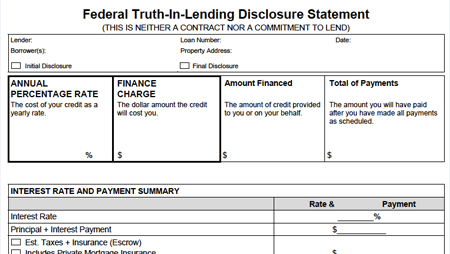
More commonly called APR, Annual Percentage Rate is a government-mandated mortgage comparison tool. It measures the total cost of borrowing over the life of a loan into dollars-and-cents.

A loan’s APR is printed in the top-left corner of the Federal Truth-In-Lending Disclosure, as shown above. When quoting an interest rate, loan officers are required by law to disclose a loan’s APR, too.

APR is meant to simplify the process of choosing between two or more loans. The theory is that the loan with the lowest APR is the “best deal” for the applicant because the loan’s long-term costs are lowest. However, the loan with the lowest APR isn’t always best.

APR makes assumptions in its formula that can render it moot.

First, APR assumes you’ll pay your mortgage off at term, at never sooner. So, if your loan is a 15-year fixed rate, its APR is based on a full 15 year term. If you sell or refinance prior to Year 15, the math used to make your loan’s APR becomes instantly flawed and “wrong”.

Example: Let’s compare two identical loans in OH — one with discount points and a lower interest rate; and one without discount points and a higher mortgage rate. The loan with discount points will have a lower APR in most cases. However, if the homeowner sells or refinances within the first few years, the loan with the higher APR would have been the better option, in hindsight.

Second, APR can be “doctored” early in the loan process.

Because the APR formula accounts for third-party costs in a mortgage transaction, and third-party costs aren’t always known at the start of a loan, a bank can inadvertently understate them. This would make the APR appear lower than what it really is, and may mislead a consumer.

And, lastly, APR is particurly unhelpful for adjustable-rate loans. Because the APR calculation makes assumptions about how a loan will adjust during its 30-year term, if two lenders use a different set of assumptions, their APRs will differ — even if the loans are identical in every other way. The lender whose adjustments are most aggressively-low will present the lowest APR.

Summarized, APR is not the metric for comparing mortgages — it’s a metric. For relevant comparison points, talk to your loan officer.
Filed Under: Uncategorized Tagged With: APR,Mortgage Math

What’s Ahead For Mortgage Rates This Week : July 11, 2011

July 11, 2011 by Jeff Cost Leave a Comment

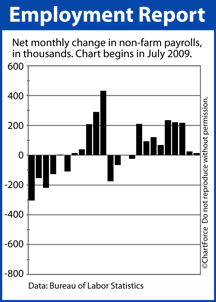
Net New Jobs 2009-2011Mortgage markets improved in roller coaster-like trading last week. And, not surprisingly, the week’s two big stories were the same two stories roiling mortgage markets since March — Greece and Jobs.

In both instances, rate shoppers won. Conforming mortgage rates in OH improved for the first time in 3 weeks last week.

Early in the week, mortgage rates fell as doubts resurfaced on the just-completed Greece aid package. Although an agreement had been reached by the Greek Parliament, investors are wondering if it’s a bona fide solution, or delaying an inevitable default.

Talk like this triggers a flight-to-quality, and last week, it led mortgage rates lower.

Then, mid-week, a strong preview of the Friday jobs report led to a reversal. Mortgage markets sold off sharply with the prospect of a blow-out Non-Farm Payrolls number. Analysts upped their estimates 50% — from 80,000 net new jobs created in June to 120,000 — and mortgage rates spiked in anticipation.

The rate rise was short-lived, however, because when the actual jobs report was released, it showed just 14,000 jobs added in June. Mortgage markets reversed and mortgage rates sunk to their best levels in 2 weeks.

This week, Greece should remain in the headlines, but there’s other rate-changing news, too:

  • Tuesday : FOMC Minutes
  • Wednesday : 10-Year Treasury Auction
  • Thursday : PPI; 30-Year Treasury Auction; Jobless Claims
  • Friday : CPI; Consumer Sentiment

If you’re still floating a mortgage rate, today marks a good week to lock. Mortgage rates could fall this week and next, but there’s more room for rates to rise than to fall. 

Lock up today’s low rates while they’re still available.

Filed Under: Mortgage Rates Tagged With: Greece,Jobs,CPI

Mid-Year Review : Were The Experts Right About The Market?

July 8, 2011 by Jeff Cost Leave a Comment

Predictions are risky businessThe year is half-over. It’s an opportune time to take stock of analyst predictions made at the start of the year, and to recognize that the “experts” can be wrong as often as they are right.

For as much experience and authority an expert brings to the conversation, though, nobody can accurately predict the future.

As such, there’s often disagreement.

Looking back to December, some housing analysts called for a market rebound this year; while others called for a fall. With respect to mortgages, some said rates had nowhere to go but up; while others expected more dips.

As a layperson, how do you know who will be right?

In short, you can’t.

Predictions are a tricky business because they’re guesses about the future based on the world as it exists today. When the predictions listed earlier were made, the world was a different place.   

A lot has changed since January:

  • Slowing job growth has suggested to slower U.S. economic growth
  • Food and energy costs have spiked, adding inflationary pressures to the economy
  • Eurozone debt issues have grown, punctuated by a near-Greek default
  • Tsunamis have caused widespread damage in Japan
  • Earthquakes, floods and volcanoes have harmed economic output

None of these events had occurred as of December, when the original predictions were made. Yet, each of these developments has made a deep impact on housing, and on the economy.  

So, what’s a Louisville homeowner to do? Think of the present instead.

First, mortgage rates are low today — extremely low by historical standards. Second, home values have been slow to rebound through most U.S. markets. Combined, these factors have made homes more affordable than it any time in recorded history. It’s not only cheap to buy a home right now, it’s cheap to refinance one, too.

Analysts are saying the home prices will rise this year, and mortgage rates will, too. Those predictions may ultimately be proven true. Until the future arrives, though, those predictions are just guesses.

Filed Under: The Economy Tagged With: Greece,Jobs,Volcano

  • « Previous Page
  • 1
  • …
  • 1263
  • 1264
  • 1265
  • 1266
  • 1267
  • …
  • 1275
  • Next Page »

Jeff Cost
Sr. Loan Officer

Cincinnati, OH Mortgage Lender
NMLS# 21688


jeffrey.cost@ccm.com

Call (513) 403-6260
Fax (941) 567-5222

Cross Country Mortgage

How can I help?

Connect with Me!

Browse Articles by Category

The Latest Articles

  • What Happens When the House You Want Has a Solar Loan Attached to It?
  • Could Paying Off a Debt Before Applying for a Mortgage Actually Be the Wrong Move?
  • Why Your First Mortgage Payment Might Be Farther Away Than You Expect
  • What’s Ahead For Mortgage Rates This Week – September 21st, 2026
nmlsconsumeraccess.org
Equal Housing Lender

Our Location

CrossCountry Mortgage, LLC
4050 Executive Park Drive, Suite 220
Cincinnati, OH 45242

Personal NMLS21688 Branch NMLS2458257
Company NMLS3029

Copyright © 2026 · Powered by MySMARTblog

Copyright © 2026 · Genesis Sample Theme on Genesis Framework · WordPress · Log in