Jeff Cost

Cincinnati Home Loan

  • Home
  • About
    • About Us
    • Privacy Policy
  • Blog
  • Resources
    • First Time Seller Tips
    • First Time Buyer Tips
    • Home Appraisal
    • Loan Checklist
    • Loan Programs
    • Loan Process
    • Mortgage FAQ
    • Mortgage Glossary
    • Get a Rate Quote
    • What to Expect at a Loan Closing: A Step-by-Step Guide
  • Apply Now
    • Online Application
    • Home Purchase
    • Home Refinance
    • Loan Comparison
  • Reviews
    • Leave a Review
  • Contact

FHA To Raise Mortgage Insurance Premiums April 1, 2012

March 2, 2012 by Jeff Cost

FHA MIP Changes April 1 2012Beginning April 1, 2012, the FHA is once again raising mortgage insurance premiums (MIP) on its newly-insured borrowers throughout Columbus and the country.

It’s the FHA’s fourth such increase in the last two years.

Beginning April 1, 2012, upfront mortgage insurance premiums will be higher by 75 basis points, or 0.75%; and annual mortgage insurance premiums will be higher by 10 basis points per year, or 0.10%.

For borrowers with a loan size of $200,000, the new MIP will add $1,500 in one-time loan costs, plus an on-going, annual $200 increase in total mortgage insurance premiums paid.

All new FHA loans are subject to the increase — purchases and refinances.

The FHA is increasing its mortgage insurance premiums because, as an entity, the FHA is insuring a much larger percentage of the U.S. mortgage market than ever before. 

In 2006, the FHA insured 2 percent of all purchase-money mortgages. In 2011, that figure jumped to 18 percent. Unfortunately, as the FHA has insured more loans, it’s number of loans in default have climbed, too, forcing the FHA to boost its reserves.

Beginning April 1, 2012, the new FHA annual mortgage insurance premium schedule is as follows :

  • 15-year loan term, loan-to-value > 90% : 0.60% MIP per year
  • 15-year loan term, loan-to-value <= 90% : 0.35% MIP per year
  • 30-year loan term, loan-to-value > 95% : 1.25% MIP per year
  • 30-year loan term, loan-to-value <= 95% : 1.20% MIP per year

In order to calculate what your FHA annual mortgage insurance premium would be on a monthly basis, multiply your beginning loan size by your insurance premium in the chart above, then divide by 12.

In addition, for loans over $625,500, beginning June 1, 2012, there is an additional 25 basis point increase to annual MIP.

To avoid paying the new FHA mortgage insurance premiums, start your FHA mortgage application today. Existing FHA-insured homeowners will not be affected by the change.

Mortgage insurance premiums will not rise for loans already made.
Filed Under: Mortgage Guidelines Tagged With: FHA, MIP, UFMIP

Case-Shiller Index Shows Home Values Rising In Detroit

March 1, 2012 by Jeff Cost

Case-Shiller Index December 2011

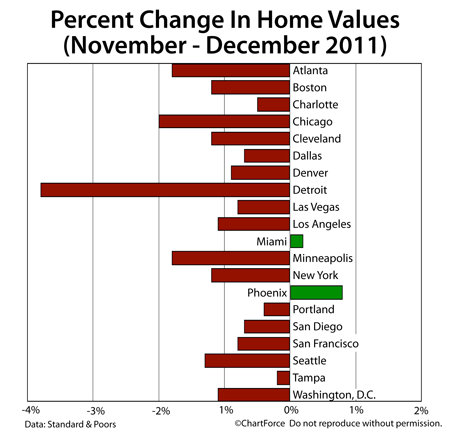
Standard & Poors released its December 2011 Case-Shiller Index this week. The report is the most widely-cited, private-sector metric for the housing market. The index aims to measures change in home prices from month-to-month, and from year-to-year, in select U.S. cities and nationwide.

According to the report, between November and December 2011, home values fell within 18 of the Case-Shiller Index’s 20 tracked markets; and through the 12 months leading up to December 2011, 19 of 20 tracked markets fell.

Only Detroit posted year-over-year gains, adding 0.50% since December 2010. 

Now, these statistics may look dire for the housing market, but it’s important to remember that the Case-Shiller Index — though widely-cited — remains a flawed statistic for everyday buyers and sellers in Columbus. Rather, the monthly Case-Shiller Index is more appropriately applied by policy-makers and economists to macro-economic issues than by you and me for buy-or-sell decisions..

There are three ways in which Case-Shiller is flawed — each tied to the way by which Case-Shiller Index is calculated.

The first reason why the Case-Shiller Index is flawed is that, although it’s purported to be a “national” housing index, the index tracks just 20 cities nationwide. The United States, by comparison, houses more than 3,100 municipalities. The Case-Shiller Index is not a representative sample of the U.S. housing market.

And then, even within its tracked markets, Case-Shiller fails provide sufficient details to be useful.

Within each Case-Shiller Index city, there are innumerable “local markets”, each with its own local economy. When home values are shown to be falling in Phoenix, for example, that doesn’t mean that values are falling everywhere in Phoenix — only in the aggregate. There are multiple neighborhoods in Phoenix in which home values improved in December.

The Case-Shiller Index doesn’t capture that. 

As another reason to ignore the Case-Shiller Index, note that the Case-Shiller Index only includes home sale data for single-family, detached homes — sales of condominiums and of multi-unit homes are specifically excluded. In some markets — Chicago and New York, for example — sales of these types can represent a large percentage of overall monthly sales.

Lastly, as a third reason to reduce the Case-Shiller Index’s significance — it’s “old”.

The Case-Shiller Index is published on a 60-day delay and includes sales contracts from even 60 days prior to that. In other words, the data used in this week’s Case-Shiller Index dates back to October 2011.

Data from 5 months ago is of little relevance to buyers in OH today. Up-to-date and current information is what matters.

For actionable, real-time housing market data, therefore, look past the Case-Shiller Index. Look to your local real estate agent instead.

Filed Under: Housing Analysis Tagged With: Case-Shiller Index, Home Values, Real-Time Data

Pending Home Sales Rise To 22-Month High

February 29, 2012 by Jeff Cost

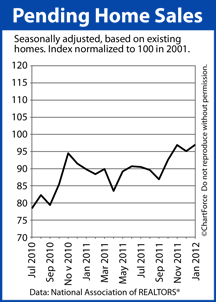
Pending Home Sales Index 2011-2012The housing market appears headed for a strong spring season.

After a brief setback in December, the Pending Home Sales Index resumed its climb in January, posting a 2 percent gain over the month prior.

The data puts pressure on Cincinnati home buyers. This is because a “pending home” is a home that’s under contract to sell, but has not yet sold. It’s tracked by the National Association of REALTORS® and, among all housing statistics, it’s the only one that’s “forward-looking”.

The Pending Home Sales Index is important to home buyers throughout Ohio because 80% of homes under contract to sell close within 60 days of contract. In this way, the Pending Home Sales Index forecasts the housing market 1-2 months into the future.

This is very different from how NAR’s Existing Home Sales report works; or, how the Census Bureau’s New Home Sales report works. These two metrics tell us what’s already happened in housing.

By contrast, the Pending Home Sales Index tells us what’s coming next.

January’s Pending Home Sales Index reading lifts the monthly metric to its highest level since April 2010 — the month during which the 2010 federal home buyer tax credit expired — foreshadowing a strong housing market through March and April 2012, at least.

This should not be news, of course. The nation’s home builders have said “foot traffic” is rising and home supplies are scarce nationwide. The only wild-card for housing is the high contract cancellation rate.

As compared to last January when just 9 percent of home purchase contracts “failed”, this January saw 33 percent of contracts fail. High failure rates undermine the Pending Home Sales Index’s viability as a forward-looking housing market indicator.

Despite contract failures, though, the combination of low mortgage rates and low home prices is enticing to today’s home buyers. Expect home sales to climb in the coming weeks which will lead to a strong spring season for housing. 

Filed Under: Housing Analysis Tagged With: Existing Home Sales, NAR, Pending Home Sales

  • « Previous Page
  • 1
  • …
  • 1216
  • 1217
  • 1218
  • 1219
  • 1220
  • …
  • 1275
  • Next Page »

Jeff Cost
Sr. Loan Officer

Cincinnati, OH Mortgage Lender
NMLS# 21688


jeffrey.cost@ccm.com

Call (513) 403-6260
Fax (941) 567-5222

Cross Country Mortgage

How can I help?

Connect with Me!

Browse Articles by Category

The Latest Articles

  • What Happens When the House You Want Has a Solar Loan Attached to It?
  • Could Paying Off a Debt Before Applying for a Mortgage Actually Be the Wrong Move?
  • Why Your First Mortgage Payment Might Be Farther Away Than You Expect
  • What’s Ahead For Mortgage Rates This Week – September 21st, 2026
nmlsconsumeraccess.org
Equal Housing Lender

Our Location

CrossCountry Mortgage, LLC
4050 Executive Park Drive, Suite 220
Cincinnati, OH 45242

Personal NMLS21688 Branch NMLS2458257
Company NMLS3029

Copyright © 2026 · Powered by MySMARTblog

Copyright © 2026 · Genesis Sample Theme on Genesis Framework · WordPress · Log in