Jeff Cost

Cincinnati Home Loan

  • Home
  • About
    • About Us
    • Privacy Policy
  • Blog
  • Resources
    • First Time Seller Tips
    • First Time Buyer Tips
    • Home Appraisal
    • Loan Checklist
    • Loan Programs
    • Loan Process
    • Mortgage FAQ
    • Mortgage Glossary
    • Get a Rate Quote
    • What to Expect at a Loan Closing: A Step-by-Step Guide
  • Apply Now
    • Online Application
    • Home Purchase
    • Home Refinance
    • Loan Comparison
  • Reviews
    • Leave a Review
  • Contact

Banks Resume Tightening Mortgage Guidelines

November 10, 2011 by Jeff Cost

Mortgage guidelines get tougher

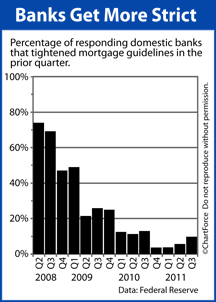
As part of its quarterly survey to member banks nationwide, the Federal Reserve asked senior loan officers whether last quarter’s “prime” residential mortgage guidelines have tightened, loosened, or remained as-is.

A “prime” borrower is defined as one with a well-documented, high-performance credit history; with low debt-to-income ratios; and who chooses to finance a home via a traditional fixed-rate or adjustable-rate mortgage product.

After a 2-year easing cycle, the nation’s biggest bank banks report that they’ve reversed course, and are raising the bar on mortgage approvals.

For the period July-September 2010, 88% of responding loan officers admitted to tightening their prime guidelines, or leaving them “basically unchanged”.

If you’ve applied for a home loan of late, you’ve experienced this first-hand.

High delinquency rates and defaults since 2007 have caused the banks to rethink what they will lend, and to whom. As a result, today’s mortgage lenders scrutinize assets, incomes, and credit scores to make sure that nothing “slips by”.

For today’s home buyers and would-be refinancers, the mortgage approval process can be challenging as compared to how it looked just 18 months ago.

  • Minimum credit scores requirements are higher today
  • Downpayment/equity requirements are larger today
  • Debt-to-Income ratio requirements are more strict today

In other words, although mortgage rates are the lowest that they’ve been in history, fewer applicants can qualify. And, with more the housing market still in recovery, it’s likely that guidelines will tighten again in 2012.

Therefore, if you’re among the many people in Louisville wondering if it’s the right time to buy a home or refinance, consider that, although mortgage rates may fall, approval standards may not.

The best rate in the world won’t matter if you’re not eligible to lock it.
Filed Under: Mortgage Guidelines Tagged With: Federal Reserve, Prime Mortgages, Senior Loan Officer Survey

This Holiday Season, Think Twice Before Saving 15 Percent At The Register

November 9, 2011 by Jeff Cost

FICO recipeWith Halloween behind us, retailers are in the Holiday Spirit. Businesses know that consumers spent a median $556 on holiday gifts last year and they want this year to be just as strong.

That’s why it’s barely November and, already, Black Friday ads clog our mailboxes and the airwaves. Retailers want our dollars and they’re offering great deals to early shoppers.

There’s one discount a smart shopper should think twice, however — the ever-present “Open A Charge Card Today And Save 15%” promotion. In the short-term, deals like this will save money. 

Over the long-term, however, opening a charge card could cost you much, much more — especially if you plan to refinance your home or buy a new one.

Applying for a charge card can lower your credit score up to 85 points.  

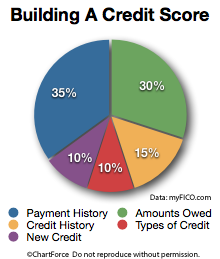
According to the myFICO.com website, as a category, “New Credit” accounts for 10% of your 850 possible credit points, comprising the following credit traits :

  • Your number of recently opened accounts
  • Your number of recent credit inquiries
  • Time elapsed since your recent credit inquiries
  • Your proportion of new accounts to all accounts

Each trait is a negative in the FICO-scoring credit algorithm which means that, with each in-store charge card application, your credit score is likely to fall. How far your score will fall depends on the rest of your credit profile.

Meanwhile, low FICO scores correlate to higher loan fees.

Using a real-life example, assuming 20% equity in a home, for either purchase or refinance, look how loan fees for a $200,000 conforming mortgage change by FICO score :

  • 740 FICO : There will be no added loan costs
  • 720 FICO : You’ll have a 0.250% increase in loan costs, or $500
  • 700 FICO : You’ll have a 0.750% increase in loan costs, or $1,500
  • 680 FICO : You’ll have a 1.500% increase in loan costs, or $3,000
  • 660 FICO : You’ll have a 2.500% increase in loan costs, or $5,000

You can see first-hand how expensive low credit score can be — much more costly than the 15% saved at the mall. That’s why people planning to refinance to today’s low rates and soon-to-be Columbus homeowners, shouldn’t rush to save 15% at the register. 

For people in want of a mortgage, high FICO scores are worth protecting.

Filed Under: Personal Finance Tagged With: Consumer Reports, FICO, Shopping

Tips For Maximizing Your Home’s Appraised Value

November 8, 2011 by Jeff Cost

Maximizing your home appraisalA home appraisal is an independent opinion of your home’s value, performed by a licensed home appraiser. Appraisals are part of the traditional home purchase process, and lenders require them for most refinances, too.

Appraisers are trained professionals. First, they derive a base for your home’s value based on the recent sales prices of homes that are comparable to yours in terms of bedrooms, bathrooms, style, and square footage.

Then, accounting for features and amenities that make your home different, the appraiser applies “adjustments” to that base value.

This methodology is called the “Sales Comparison” approach and the result is your home’s appraised value.

It’s the most common appraisal method used by lenders.

As a homeowner in Louisville , you can’t affect the sales prices of your home’s comparable properties, but you can help your appraiser understand how your home stands apart from these homes. This, in turn, can affect your home’s adjustments, resulting in a higher appraised value.

With home appraisals, every valuation dollar can matter. With that in mind, here are a few tips for maximizing your home’s appraised value :

  1. Be home for your appraisal so you can answer the appraiser’s question, if there are any.
  2. Mention any new roofing, flooring, HVAC, plumbing, or windows you’ve installed since purchase.
  3. Don’t mention projects or repairs you’re “about to undertake”. Appraisers don’t credit for unfinished projects.
  4. Make minor household fixes prior to the appraisal (e.g.; leaky sink, running toilet, peeling paint). 
  5. Present a tidy home. This can contribute to a higher “overall condition” adjustment.

Lastly, schedule the appraisal for a time that is convenient for your entire household. An appraiser needs to see, measure, and take photos of every room in your home. If a room’s door is closed because of a resting child, for example, the appraiser may need to schedule a second appointment to complete the appraisal, and that can raise your appraisal costs.

Filed Under: Personal Finance Tagged With: Appraisal, Appraiser, Sales Comparison

  • « Previous Page
  • 1
  • …
  • 1191
  • 1192
  • 1193
  • 1194
  • 1195
  • …
  • 1232
  • Next Page »

Jeff Cost
Sr. Loan Officer

Cincinnati, OH Mortgage Lender
NMLS# 21688


jeffrey.cost@ccm.com

Call (513) 403-6260
Fax (941) 567-5222

Cross Country Mortgage

How can I help?

Connect with Me!

Browse Articles by Category

The Latest Articles

  • What Lenders Look for Beyond Your Income
  • Preparing Financially for a Jumbo Loan Application
  • What’s Ahead For Mortgage Rates This Week – March 23rd, 2026
  • How Credit Score Changes Impact Your Loan Pricing
nmlsconsumeraccess.org
Equal Housing Lender

Our Location

CrossCountry Mortgage, LLC
4050 Executive Park Drive, Suite 220
Cincinnati, OH 45242

Personal NMLS21688 Branch NMLS2458257
Company NMLS3029

Copyright © 2026 · Powered by MySMARTblog

Copyright © 2026 · Genesis Sample Theme on Genesis Framework · WordPress · Log in