
Jeff Cost

Cincinnati Home Loan

  • Home
  • About
    • About Us
    • Privacy Policy
  • Blog
  • Resources
    • First Time Seller Tips
    • First Time Buyer Tips
    • Home Appraisal
    • Loan Checklist
    • Loan Programs
    • Loan Process
    • Mortgage FAQ
    • Mortgage Glossary
    • Get a Rate Quote
    • What to Expect at a Loan Closing: A Step-by-Step Guide
  • Apply Now
    • Online Application
    • Home Purchase
    • Home Refinance
    • Loan Comparison
  • Reviews
    • Leave a Review
  • Contact

Lock Your Mortgage Rate : New Loan Fees Expected Within Days

January 10, 2012 by Jeff Cost

Payroll tax fees for new loansStarting soon, nearly all home buyers and refinancing households throughout Kentucky and nationwide will pay higher mortgage loan fees. Congress has made it law.

13 months ago, as part of the Tax Relief, Unemployment Insurance Reauthorization, and Job Creation Act of 2010, Congress enacted a one-year cut to FICA payroll taxes.

FICA stands for Federal Insurance Contributions Act. Taxes collected under FICA fund such programs as Social Security and Medicare.

The stimulus plan temporarily lowered tax rates for salaried workers from 6.2% to 4.2%; and for self-employed persons from 12.4% to 10.4%. Effective January 1, 2012, “regular” tax rates were to return.

That is, until late-December 2011. In one of its last moves of the year, Congress passed a temporary, two-month extension to the payroll tax cut, extending it through February 29, 2012. The expected cost to the U.S. Treasury is $33 billion.

To recoup those costs, Congress has turned to Fannie Mae, Freddie Mac and the FHA.

Each entity has been ordered to collect news fees on each new mortgage is backs, and has been told to forward said fees to U.S. Treasury directly. There’s no “workaround” allowed or forgiveness applied — each new loan is subject to the payment. 

The rules are listed on page 17 of the law’s final draft, in a section unambiguously titled “Title IV — Mortgage Fees and Premiums”.

According to the law :

  • Fannie Mae and Freddie Mac must collect an average fee of no less than 10 basis points (0.1%) per new loan
  • The FHA must raise its monthly mortgage insurance premiums 10 basis points for all new loans

The expected cost to consumers is no less than $10 monthly per $100,000 borrowed. Some analysts, however, expect Fannie Mae and Freddie Mac to collect more than is minimally required. This could add an additional $30-50 to your monthly mortgage payment per $100,000 borrowed.

Therefore, if you’ve been shopping for a home or for mortgage rates in Cincinnati , take advantage. Within days, lenders are expected to start collecting Payroll Tax Extension fees from mortgage applicants — a move that will cost you money.

Lock today to avoid the big fees. Save yourself money.
Filed Under: The Economy Tagged With: Congress, FICA, Payroll Tax

What’s Ahead For Mortgage Rates This Week : January 9, 2012

January 9, 2012 by Jeff Cost

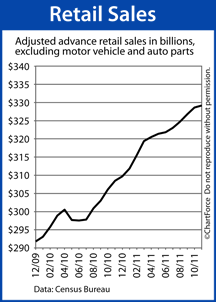
Retail Sales 2009-2011Mortgage markets improved last week, pushing mortgage rates in Kentucky lower for the second straight week. Conforming fixed and adjustable-rate mortgage cut new, all-time lows, and FHA mortgage rates did the same.
In a holiday-shortened trading week, stronger-than-expected U.S. economic data and ongoing weakness within Europe drove investors into the U.S. mortgage-backed bond market. When demand for bonds is high, mortgage rates improve.

The Refi Boom continues.

Since beginning their descent last February, mortgage rates have shed 114 basis points en route to reaching 3.91%, the current, “average”, 30-year fixed rate mortgage rate nationwide and a new all-time low, according to Freddie Mac and its mortgage market survey. If you’re among today’s home buyers or would-be refinancers, on a $200,000 mortgage, the 1.14% rate drop represents a monthly mortgage payment savings of $135 — $1,623 per year.

Larger loans save more, smaller loans save less.

This week, with little economic news set for release, mortgage rates are expected to take their cue from the 8 Federal Reserve members scheduled to speak in public, and from whatever news may bubble up from the Eurozone.

The Federal Reserve said it will communicate its vision for the U.S. economic more openly and more often so Wall Street will be watching the Fed members’ speeches this week, in search of clues about the Fed’s 2012 roadmap.

For example, there has been speculation that a new round of stimulus would be introduced at the Fed’s next meeting later this month. If, after listening to this week’s speeches, investors sense it will happen, mortgage rates may be susceptible to an increase in Louisville and everywhere else.

We’ll also be watching the Retail Sales report this week, due Thursday. Retail Sales are a reflection on consumer spending and consumer spending accounts for roughly 70% of the U.S. economy. If Retail Sales make gains, it may spark stock market gains at the expense of mortgage bonds.

This, too, would result in higher mortgage rates.

You can’t time the mortgage market, but with mortgage rates this low, it’s hard to go wrong. Talk with your loan officer to get a live rate quote.

Filed Under: Mortgage Rates Tagged With: Eurozone, Federal Reserve, Retail Sales

Adjustable-Rate Mortgages Are A Relative Bargain Today

January 6, 2012 by Jeff Cost

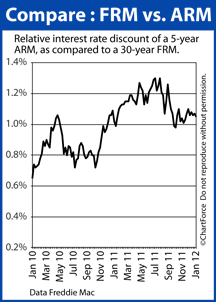
Comparing 30-year fixed to 5-year ARMFor buyers and refinancing households throughout Ohio , adjustable-rate mortgages are a relative bargain as compared to fixed-ones.

According to Freddie Mac’s weekly survey of more than 125 banks nationwide, Louisville mortgage applicants electing for a conventional ARM over a conventional fixed-rate mortgage will save 105 basis points on their next mortgage rate.

“Conventional” loans are loans backed by Fannie Mae or Freddie Mac.

Today’s average, conventional 30-year fixed rate mortgage rate is 3.91% plus points and closing costs. The average rate for a comparable 5-year ARM is 2.86%, plus points and closing costs.

In other words, for every $100,000 borrowed, a conventional 5-year adjustable-rate mortgage will save you $58.15 per month, or $698 per year.

That’s a 12 percent savings just for choosing an ARM.

12 percent is a big figure that adds up over 5 years — especially for households that plan to sell within those first 60 months anyway. There is little sense in paying the mortgage rate premium for a 30-year fixed-rate mortgage when a 5-year ARM is perfectly suitable.

For the reason why adjustable-rate mortgages continue are so much lower than their fixed-rate counterparts, look no further than the U.S. economy. ARMs reflect Wall Street’s short-term economic expectations; whereas fixed-rate mortgages reflect medium- to long-term expectations.

In the short-term, analysts expect the U.S. economy to grow slowly, with low levels of inflation. This supports the U.S. dollar, the currency in which mortgage bonds are denominated. When the dollar is strong, demand for mortgage bonds tends to increase.

This supports lower interest rates.

Conversely, over the longer-term, inflation is expected to return, which devalues the dollar and everything paid in it (e.g.; mortgage-backed bonds). This is why inflation is linked to higher mortgage rates. When inflation is present in the economy, mortgage bonds lose value, driving mortgage rates up.

Adjustable-rate mortgages aren’t perfect for everyone, but in the right situation, they can be a big money-saver and a helpful tool for stretching a household budget. Given today’s rates, the money-saving potential is larger than usual.

Before you choose an ARM, discuss your options with your loan officer.

Filed Under: Mortgage Rates Tagged With: ARM, Freddie Mac, FRM

  • « Previous Page
  • 1
  • …
  • 1185
  • 1186
  • 1187
  • 1188
  • 1189
  • …
  • 1232
  • Next Page »

Jeff Cost
Sr. Loan Officer

Cincinnati, OH Mortgage Lender
NMLS# 21688


jeffrey.cost@ccm.com

Call (513) 403-6260
Fax (941) 567-5222

Cross Country Mortgage

How can I help?

Connect with Me!

Browse Articles by Category

The Latest Articles

  • What Lenders Look for Beyond Your Income
  • Preparing Financially for a Jumbo Loan Application
  • What’s Ahead For Mortgage Rates This Week – March 23rd, 2026
  • How Credit Score Changes Impact Your Loan Pricing
nmlsconsumeraccess.org
Equal Housing Lender

Our Location

CrossCountry Mortgage, LLC
4050 Executive Park Drive, Suite 220
Cincinnati, OH 45242

Personal NMLS21688 Branch NMLS2458257
Company NMLS3029

Copyright © 2026 · Powered by MySMARTblog

Copyright © 2026 · Genesis Sample Theme on Genesis Framework · WordPress · Log in