Jeff Cost

Cincinnati Home Loan

  • Home
  • About
    • About Us
    • Privacy Policy
  • Blog
  • Resources
    • First Time Seller Tips
    • First Time Buyer Tips
    • Home Appraisal
    • Loan Checklist
    • Loan Programs
    • Loan Process
    • Mortgage FAQ
    • Mortgage Glossary
    • Get a Rate Quote
    • What to Expect at a Loan Closing: A Step-by-Step Guide
  • Apply Now
    • Online Application
    • Home Purchase
    • Home Refinance
    • Loan Comparison
  • Reviews
    • Leave a Review
  • Contact

Case-Shiller Index : 17 Of 20 U.S. Housing Markets Slipped In September

November 30, 2011 by Jeff Cost

Case-Shiller Index September 2011

Standard & Poor’s released its September 2011 Case-Shiller Index this week. The index tracks home price changes in select cities between months, quarters, and years.

The Case-Shiller Index for September showed drastic devaluations nationwide.

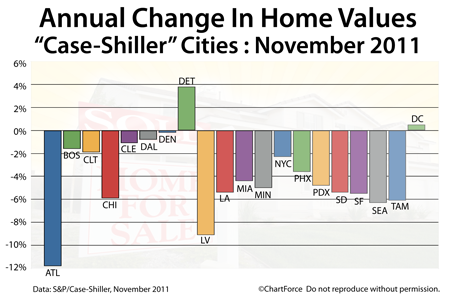
As compared to August, home values fell throughout 17 of the index’s 20 tracked markets, led by Atlanta’s 5.9% drop. On an annual basis, home values have now returned to early-2003 levels.

That said, home buyers and sellers in the Montgomery area should be cautious when referencing the Case-Shiller Index. The index is a flawed metric and, as such, can lead to improper conclusions about the housing market overall.

The Case-Shiller Index’s first flaw is its most obvious — its limited sample set. 

According to Wikipedia, there are more than 3,100 municipalities nationwide. Yet, the Case-Shiller Index includes data from just 20 of them in its findings. These 20 cities account for fewer than 1% of all U.S. cities, and just a small percentage of the overall U.S. population. 

The “national figures” aren’t really national, in other words.

Even on a city-by-city basis, the Case-Shiller Index gets it wrong.

By lumping disparate neighborhoods into a single, city-wide result, the index ignores the relative strength of one area at the expense of another. In the aforementioned Atlanta, there are areas that fared much better than September’s -5.9% as cited by Case-Shiller. Some areas fared much worse.

A second flaw in the Case-Shiller Index is it’s methodology for measuring changes in home value. The index only considers “repeat sales” of the same home in its findings, and those homes must be single-family, detached property. Condominiums, multi-family homes, and new construction are not included.

In some cities — Chicago, for example — “excluded” property types can account for a large percentage of total monthly sales.

And, third, the Case-Shiller Index is flawed by “age”.

Because Standard & Poor’s publishes on a 60-day delay, the Case-Shiller Index is reporting on a housing that no longer exists. Sales that closed in September are based on contracts written from June-August –a time-frame that’s 6 months aged.

The best use of the Case-Shiller Index is as an analysis tool for economists and policy-makers interested in the long-term trends of U.S. housing. The index does very little good for every day buyers and sellers, unfortunately.

For up-to-date, accurate market data, talk to a real estate professional instead.

Filed Under: Housing Analysis Tagged With: Case-Shiller Index, Home Values, Standard & Poor's

New Home Supplies Fall To An 18-Month Low

November 29, 2011 by Jeff Cost

New Home Supply 2009-2011

If you plan to buy of new construction in OH sometime in 2012, don’t expect today’s low prices. Like everything in housing of late, the market for newly-built homes appears to be stabilizing and, in some markets, improving.

As foreshadowed by this month’s strong Homebuilder Confidence survey, the Census Bureau reports that the number of new homes sold rose to a 6-month high in October, climbing to 307,000 units on a seasonally-adjusted, annualized basis.

A “new home” is a home that is considered new construction. It’s the opposite of an “existing home”.

Home buyers are comparing new construction to home resales and liking what they see. At the current sales pace, the nation’s complete new home inventory would now be depleted in just 6.3 months. This marks the lowest home supply since April 2010 — the last month of the last year’s federal homebuyer tax credit.

By building only to meet new demand, builders are keeping home supplies in check, and home prices stable. They’ve also found a niche market — 80% of homes sold last month sold for less than $300,000.

Split by region, the Census Bureau reports October’s New Home Sales as follows :

  • Northeast Region : +0.0% from September 2011 
  • Midwest Region : +22.2% from September 2011 
  • South Region : -9.5% from September 2011 
  • West Region : -14.9% from September 2011 

Unfortunately, the data may be incorrect.

Although the October New Home Sales report says that sales climbed 1.3 percent last month, the government’s data was published with a ±19.7% margin of error. This means that the actual New Home Sales reading may have been as high as +21.0 percent, or as low as -18.4 percent. Because the range of values includes both positive and negative values, the Census Bureau assigned its October data “zero confidence”.

As home buyers, then, we can’t take our market cues from the published data. Instead, we should look to other metrics including Housing Starts data and the aforementioned homebuilder confidence survey. Each points to strength in the new home market, and foretells higher home prices in 2012.

If you’re in the market for new construction, consider writing an offer soon. Home prices remain low and mortgage rates do, too — a combination that keeps home payments low. Next year, that may not be the case.

Filed Under: Housing Analysis Tagged With: Margin of Error, New Home Sales, New Home Supply

What’s Ahead For Mortgage Rates This Week : November 28, 2011

November 28, 2011 by Jeff Cost

Non-Farm Payrolls Nov 2009-Oct 2011Mortgage markets worsened slightly last week through a bouncy, holiday-shortened trading week. Markets were closed Thursday for Thanksgiving and re-opened only briefly Friday.

As in past weeks, though, economic, political, and financial news from the Eurozone dictated the direction of U.S. mortgage-backed bonds.

As Greece — and now Italy — have faltered, investors have sought to preserve their respective principal, moving money from unsafe assets to safe ones, a class which includes Fannie Mae- and Freddie Mac-backed mortgage bonds.

This investment pattern is known as “safe haven” buying and it’s why mortgage rates tend to improve when large economies grow unstable. Government mortgage bonds are considered among the safest securities available.

The average 30-year fixed rate mortgage is available for 3.98%, according to Freddie Mac, with borrowers expected to pay an accompanying 0.7 discount points. 1 “discount point” is a loan fee equal to 1 percent of your loan size.

“No-point loans” carry higher rates than the Freddie Mac-published figures, but come with lower closing costs.

This week, there are several reasons to expect mortgage rates to rise throughout OH.

First, markets are speculating that the IMF will lend Italy 600 billion euro to help avert financial crisis. This move would reverse the safe haven buying that’s characterized the last few weeks of trading, thereby leading mortgage rates higher.

A second reason is that they are early reports that Black Friday shoppers out-spent analyst estimates. Consumer spending is the largest part of the U.S. economy so, if spending is up, the economy should be up, too. 

As before, this would reverse some of the safe haven buying that’s helped keep mortgage rates low.

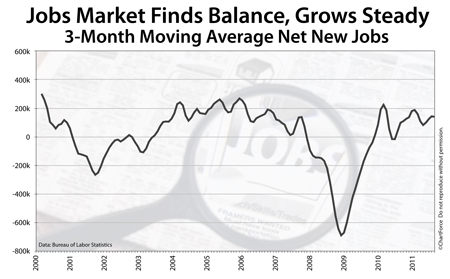
Lastly, this week is stuffed with new data including Friday’s always-important Non-Farm Payrolls report. Wall Street expects 116,000 net new jobs created in November. If the actual figure is much higher, mortgage rates will rise.

Expect mortgage rates to be volatile this week. Your quoted mortgage rates could vary by as much as a quarter-percent from day-to-day. If you’re nervous about losing a low rate that’s been offered to you, consider locking in.

Filed Under: Mortgage Rates Tagged With: Eurozone, Italy, Non-Farm Payrolls

  • « Previous Page
  • 1
  • …
  • 1179
  • 1180
  • 1181
  • 1182
  • 1183
  • …
  • 1222
  • Next Page »

Jeff Cost
Sr. Loan Officer

Cincinnati, OH Mortgage Lender
NMLS# 21688


jeffrey.cost@ccm.com

Call (513) 403-6260
Fax (941) 567-5222

Cross Country Mortgage

How can I help?

Connect with Me!

Browse Articles by Category

The Latest Articles

  • Why a HELOC Works and When It Might Make Sense for Homeowners
  • What Homebuyers Need to Know About Mortgage Interest Rates and APR
  • What Every Homebuyer Needs to Know About Mortgage Origination Fees
  • 5 Financial Signs You Are Ready to Qualify for a Mortgage
nmlsconsumeraccess.org
Equal Housing Lender

Our Location

CrossCountry Mortgage, LLC
4050 Executive Park Drive, Suite 220
Cincinnati, OH 45242

Personal NMLS21688 Branch NMLS2458257
Company NMLS3029

Copyright © 2026 · Powered by MySMARTblog

Copyright © 2026 · Genesis Sample Theme on Genesis Framework · WordPress · Log in